
Compaction, Salinity, and Water Infiltration: Soil Management on 3 Saskatchewan Farms
THE SHORT ANSWER Many Saskatchewan farms deal with soil compaction, salinity and poor water infiltration, but no two manage them the same way. Soil health practices in Saskatchewan rest on the same core principles: disturb the soil less, diversify crops, keep the soil covered, keep living roots in the ground and integrate livestock. The right starting point depends on your land, your finances and the problem you most need to solve. |
Visit three Saskatchewan farms and you'll get three different answers to the same question: how do you build healthier soil and still run a profitable business?
This article looks at soil health practices in Saskatchewan through the eyes of three producers: a grain farmer in the west-central region, a partner in a growing southeast operation and a mixed farmer in the east-central parkland who has been applying regenerative practices for years. You'll learn how each farm struggles with soil compaction, salinity and water infiltration, how it measures and manages its soil, and where each is still working on it.
It's drawn from SaskSoil's webinar Managing for Healthy Soil: Insights from Three Saskatchewan Farms, hosted by Executive Director Katelyn Duncan and supported by the Farm Resilience Mentorship Program (FaRM) delivered by Farmers for Climate Solutions.[6]
WATCH THE WEBINAR  Watch the full webinar on YouTube: https://youtu.be/5useXlLkL3k Jeff Bennett, Paige Stewart and Rob Wunder join SaskSoil Executive Director Katelyn Duncan to compare how they manage for soil health on three very different Saskatchewan farms. |
Meet the Panel
Jeff Bennett | Paige Stewart | Rob Wunder | |
Location | Near Dodsland, west-central SK | North of Fillmore, southeast SK | South of Foam Lake, east-central SK |
Soil zone | Brown/Dark Brown | Dark Brown | Black |
Operation | Fourth-generation grain farm: canola, fenugreek and canary seed, plus a small bison herd | Managing partner, Four Mile Partnership: six-crop rotation and a new cattle enterprise | Fourth-generation mixed farm, roughly half perennial and half annual acres, with cow-calf pairs, yearlings and backgrounded calves |
Guiding value | Efficiency and measurement | Diversity and agility | Living roots and livestock integration |
Challenges | Compaction and salinity | Bare soil after pulse crops | Water infiltration in wet years |
What are the core soil health practices used in Saskatchewan?
Soil health practices in Saskatchewan follow six principles: minimize soil disturbance, maximize crop diversity, keep the soil covered, maintain living roots, integrate livestock and understand the context of your own operation. The Government of Saskatchewan promotes the same framework,[1] but how each farm applies it depends on soil zone, moisture, equipment and budget.
The soil health principles at a glance
Most soil health frameworks start from the same short list. The USDA Natural Resources Conservation Service names four core principles.[8] The University of Saskatchewan and Saskatchewan Agriculture add livestock integration, and SaskAg also asks producers to consider their own operation.[1][9] Here's what each principle means on a Prairie farm:
Minimize soil disturbance. Every tillage pass, extra field operation and even heavy traffic breaks down soil structure and the fungal networks that hold it together. Zero-till, fewer passes and limiting where equipment travels all reduce disturbance.
Keep the soil covered (soil armour). Crop residue, mulch or growing plants protect the surface from wind and water erosion. Cover also cools the soil, reduces evaporation and crusting, and feeds soil life.
Maximize diversity. More crop types, cover crop mixes and intercrops bring different root systems and residues into the soil. That breaks disease and weed cycles and supports a wider range of soil organisms.
Keep a living root in the ground. Living roots feed soil microbes, hold soil in place and keep water moving into the profile. Reducing fallow periods, and using perennials, cover crops and companion crops, extends the time roots are growing.
Integrate livestock. Grazing cycles nutrients back to the soil as manure and turns residue and forage into biological activity. It can also cut feeding costs.
Understand your context. Soil zone, moisture, equipment, finances and family goals all shape which principle to start with. This is why no two farms look the same.
Saskatchewan producers have already made big progress on the first principle. According to the Government of Saskatchewan, 74.4 per cent of the province's cropland acres were zero-till by the 2016 Census, and 93 per cent used some form of conservation tillage.[1]
That shift happened within living memory. Paige Stewart's farm near Fillmore has been in zero-till since about 1997, and her husband's uncle was one of the first in the area to make the switch. "That's not that long ago," she said
.
A 2026 University of Saskatchewan study shows what that shift has meant for the soil. The researchers surveyed Saskatchewan farmers across the Brown, Dark Brown and Black/Grey soil zones. From the early 1990s to 2020–2024, average tillage passes fell 76 per cent and the share of fields in summerfallow fell 91 per cent. Over the same period, average soil organic matter rose 41 per cent, from 3.33 to 4.71 per cent.[10]

The organic matter numbers come from farmers' own soil tests, not controlled research plots. Treat them as a province-wide trend rather than a promise for any one field.
The next frontier is the rest of the principles, and that's where the three farms take very different paths. As Katelyn Duncan put it, soil health "is different on every farm." For some, it's a fully regenerative system. For others, it's a first cover crop, livestock or more efficient nitrogen.
How do you measure soil health on your farm?
You measure soil health by sampling the same areas of a field over time and tracking indicators such as organic matter, nutrients and moisture. Using the same lab each year keeps results comparable. Pairing those numbers with prescription, weather and cost data shows which parts of a Saskatchewan field actually improve and pay.
Jeff Bennett, who farms near Dodsland, calls his strength "testing, with a goal to it." He has used variable rate fertilizer and seed for years and tracks soil organic matter by zone, with the aim of raising it over time.
“I don't think a lot of farmers, even if they do test their soil, have an idea of what they want to do with it. My goal is always to improve it.” — Jeff Bennett, grain producer, Dodsland, SK. SaskSoil webinar, Managing for Healthy Soil: Insights from Three Saskatchewan Farms, summer 2026.[7]
Jeff's agronomist sets up benchmark sampling sites: the same representative areas, sampled year after year. Knowing each area's prescription and the season's weather, he can estimate how efficiently moisture and fertilizer were used, then add financial results. Over a few years, that shows which parts of a field lose money no matter what goes on them.
That approach matches the Government of Saskatchewan's advice. In a July 2026 article, agri-environmental specialist Jacqueline Drieschner noted that soil health results can vary by lab and method, and recommended producers "use the same soil testing lab for consistent measurements" to benchmark and track change over time.[2]
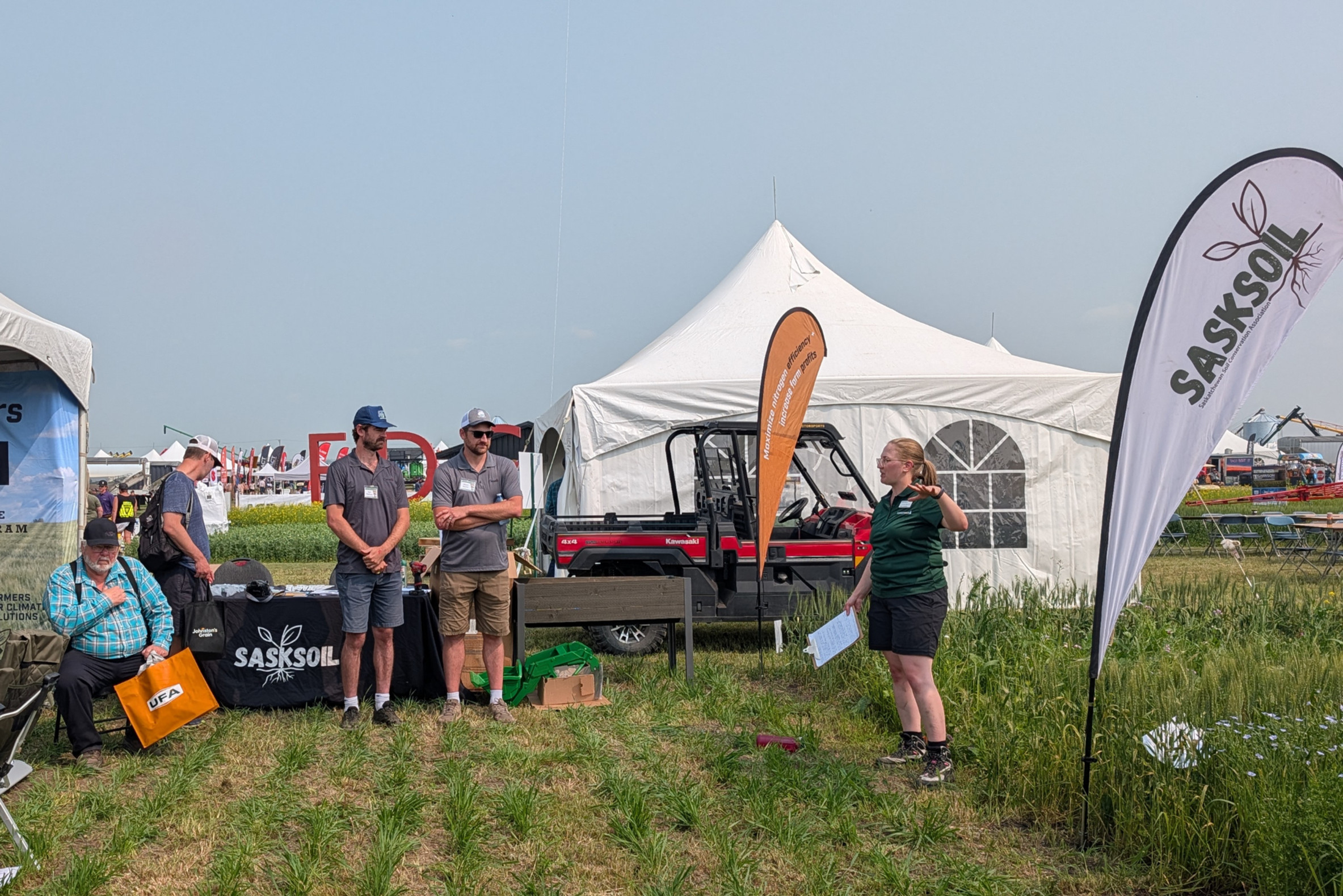
Researchers are also working toward a standard: the University of Saskatchewan's Saskatchewan Assessment of Soil Health (SASH) scorecard, developed by Qianyi Wu and Kate Congreves.[4]
ON-FARM TIP Jeff cut his fertilizer rates by about 15 per cent this season, using benchmark sites to track the results. At the time of the webinar the crop looked strong, but the grain wasn't yet in the bin. Treat any rate cut as a trial with measurement, not a blanket recommendation. |
Can you improve saline patches instead of seeding them to grass?
You can sometimes improve mild saline patches by stopping fertilizer on them, which avoids adding more salts, and raising seeding rates so more plants compete. Severe salinity usually needs a salt-tolerant perennial forage. In Saskatchewan, the right answer depends on how salty the patch is and what it currently costs you.
Jeff's father told him his whole life that saline ground can't be improved and should be seeded to grass. Jeff's answer: "Sure. But can I try first?"
By stopping fertilizer on salt patches and increasing the seeding rate, Jeff has areas that now grow a grain crop. He's also trialling products on the worst spots.
Paige came to a similar conclusion from the other direction. Her farm took a 15-acre patch out of annual crop and seeded it to grass.
“I think some farms would look at us taking out a 15-acre patch and seeding grass there, where we had a wide-open field, as inefficient. But to me, it's inefficient to put fertilizer there and not grow anything.” — Paige Stewart, managing partner, Four Mile Partnership, Fillmore, SK. SaskSoil webinar, Managing for Healthy Soil: Insights from Three Saskatchewan Farms, summer 2026.[7]
For severely salt-affected land, the Government of Saskatchewan's guide to the nature and management of salt-affected land is the place to start. It covers salt-tolerant forages such as AC Saltlander, a saline-tolerant perennial forage for Western Canada.[3]
How does crop diversity improve soil health?
Crop diversity improves soil health by varying root depths, residue types and nutrient demands. That helps break disease and weed cycles, uses soil water more efficiently and keeps the surface covered. In parts of southeast Saskatchewan where many farms grow three crops or fewer, adding even one or two crops is a practical, low-cost step.
Asked what her farm does best, Paige didn't hesitate: crop rotation. "There's very few farms near us that have more than three crops," she said. Some neighbours have dropped pulses entirely for a wheat-canola rotation. Her farm grows six: wheat, oats, peas, lentils, canola and camelina.
That diversity does double duty: varied root systems help with compaction, and the crops leave plenty of residue, especially oats.
Her farm runs an older paired-row air drill that handles heavy residue, so fields don't need harrowing. That's one less pass exposing bare soil.
Research backs up the rotation effect. The Government of Saskatchewan cites Swift Current research showing that alternating deeper-rooted crops such as canola and wheat with shallower-rooted pulses improves soil water use efficiency.[1] Rob Wunder added that the amount of high-carbon crops (like cereals, flax and corn that leave a lot of residue behind) in a rotation is "something very overlooked" when managing compaction and organic matter.
How can you integrate livestock into a grain farm?
You can integrate livestock into a grain farm by grazing crop residue, cover crops or forage on problem acres, bale or corral grazing on fields, or partnering with a neighbour's herd. Start where land, water and fencing already line up. Saskatchewan producers use everything from winter feeding on cropland to adaptive grazing of perennials.

Just starting: Paige Stewart
Last summer, kochia surrounded Paige's yard despite five or six different control options. The farm pulled the home half out of grain and seeded its first forage crop, which it cut for greenfeed this summer.
The plan is to start with corral feeding, move to bale grazing on low and poor spots, and later add virtual fencing and grazing corn. The farm has 12 quarters within two miles of each other, with water in the middle. After a holistic management course, the family realized they could even calve in June.
Decades in: Rob Wunder
Rob Wunder is a fourth-generation mixed farmer south of Foam Lake and a former SaskSoil board member. His family has wintered cattle on cropland for almost 30 years. It started during the BSE years as a way to cut costs, and because his dad didn't like hauling manure.
Today his grazing is adaptive. Cattle move off perennials onto annual cropland in the shoulder seasons, especially fall, which rests the perennial stands. Before a pasture goes back to annual crop, he grazes it hard to turn as much biomass as possible into manure. Compost from bedding packs is applied as an extract through a liquid kit on the drill.
Livestock-curious: Jeff Bennett
Jeff has a small bison herd but doesn't yet graze his cropland. He has picked out fields near the yard and pasture where it could fit.
The Government of Saskatchewan notes that livestock excrete about 90 per cent of the nitrogen in their feed, and wintering cattle on fields can reduce yardage and manure-hauling costs. Choose sites away from surface water to limit nutrient runoff.[1]
DON'T FORGET QUALITY OF LIFE "I gotta be careful, I could spend all day fencing if I'm not thinking clearly," Rob said. With young kids at home, he now weighs family time alongside soil health goals when planning grazing. |
What causes soil compaction in Saskatchewan, and how do you fix it?
Soil compaction in Saskatchewan is mostly caused by heavy equipment on wet soil, repeated traffic in fill areas and headlands, and rolling pulse crops. It often forms below the surface, where you can't see it. Living roots, diverse rotations, lighter or limited traffic and carefully targeted tillage are the main tools producers use to manage it.
Compaction was the one issue all three panelists shared. For Jeff, it shows most where equipment fills. After a wet spring and a dry summer, wheel tracks stayed visible for years. He explained it this way: "I can see where I drove for the next three years." He now keeps filling to one part of each field.
Paige saw her headlands "banged right out" in a year when pulses made up about 40 per cent of her acres, because every pulse field is rolled. Using larger trucks, such as Super B’s in place of tandems, add to the load.
The most striking finding came from her soil moisture probes, which track both moisture and where the crop is drawing nutrients from.
“We're getting down to that 70 centimetres, and those [canola] roots cannot penetrate through. Looking at the crop from the top, you can't see any compaction.” — Paige Stewart, managing partner, Four Mile Partnership, Fillmore, SK. SaskSoil webinar, Managing for Healthy Soil: Insights from Three Saskatchewan Farms, summer 2026.[7]
Below that layer, the probes showed nitrogen and phosphate the canola couldn't reach. Paige estimates it at about 30 pounds, and on her farm phosphate is the limiting nutrient.
Compaction options the panel discussed
Option | How it works | Trade-offs raised |
Mechanically fractures a hardpan layer | Expensive and disruptive to soil structure and biology | |
Taproot crops and perennials | Roots open channels through compacted layers over time | Takes acres out of annual crop for one or more seasons |
Living roots and fine grassy roots | Keeps soil structure open where you drive most | Needs to be paired with herbicide plans that still protect the cash crop |
Limiting traffic to fill zones | Confines damage to one known area of the field | Doesn't fix the compaction already in that area |
Loosens a problem spot quickly | Only works if something is planted right after |
Rob's approach is to keep "a living root there to drive on as much as possible." He points out that the roots don't need to be large: "just a fine grassy root." Where the soil is resilient enough, he will occasionally use tillage, on one condition.
“As soon as we loosen something up, I want to be planting something in there.” — Rob Wunder, mixed farmer, Foam Lake, SK. SaskSoil webinar, Managing for Healthy Soil: Insights from Three Saskatchewan Farms, summer 2026.[7]
Other Prairie farmers report the same thing. In Grainews, producers describe compaction that lingers for years because freeze-thaw cycles can't keep up with today's equipment weights.[5]
How does soil health affect water infiltration?
Healthy soil with good structure and living roots absorbs water faster. That reduces ponding, runoff and drowned-out spots in wet years and stores more moisture for dry ones. Perennials are one of the quickest ways to rebuild infiltration on problem ground, which is why soil health belongs in every Saskatchewan water management conversation.
In a wet 2026, Rob saw where his soil still falls short. "You think you're on the right path, and then Mother Nature just shows you how much more work you have ahead of you," he said. Hilltops weren't taking in moisture, and low spots flooded.
His long-term fix is more perennials, including on rented land. After talking with the land manager, he will seed one rented quarter to perennials when the lease renews next year. The only condition is that the field must go back into annual production at the end of the term.
On one of his own fields, the half seeded to perennials for just a couple of years still shows a clear line from the road.
Katelyn noted that soil health is often left out of water management discussions, even though soil is "upstream" of drainage decisions.

The Saskatchewan Association of Watersheds offers a program that works to increase the adoption of best management practices that address issues related to climate change in agriculture. Producers can access funding to implement improved nitrogen management practices, incorporate rotational grazing practices and adopt cover crops into their rotations.
What soil health mistakes do Saskatchewan farmers want to avoid?
The panel was candid about their own gaps. Here are the pitfalls they named:
Leaving soil bare after pulses. Paige's biggest regret is having no cover crop after peas and lentils. The soil sits bare all winter, and extra herbicide passes kill even the weed roots holding it.
Testing without a goal. Jeff's view: a soil test only matters if you know what you're trying to change.
Treating the whole field the same. Saline, compacted and productive zones need different rates, and sometimes different crops.
Confusing efficiency with bigger, faster passes. Farming around a 15-acre grass patch can be more efficient than fertilizing ground that grows nothing.
Loosening soil and leaving it bare. If you till a problem area, plant something right away.
Forgetting the people. On a multi-family farm, Rob says the hardest part is balancing different priorities, and fatigue is a real cost.
In their own words: advice from three Saskatchewan farms
“This is a business, but the business isn't necessarily selling crops. It's being a steward of the land and making your soil more healthy.” — Jeff Bennett, grain producer, Dodsland, SK. SaskSoil webinar, Managing for Healthy Soil: Insights from Three Saskatchewan Farms, summer 2026.[7]
Jeff has three young sons who all say they want to farm. His goal is to hand on land that is better both for soil health and financially than when he took it over.
“We're not super large as far as acres go, but we're very management intensive, trying to go up instead of out.” — Rob Wunder, mixed farmer, Foam Lake, SK. SaskSoil webinar, Managing for Healthy Soil: Insights from Three Saskatchewan Farms, summer 2026.[7]
Rob credits most of his ideas to other farmers, and the learning goes both ways: Paige said a presentation Rob gave a few years ago is part of the reason her farm now runs cattle. Farmer-to-farmer learning is at the heart of SaskSoil's events.
Frequently asked questions
What is the most important soil health practice for Saskatchewan farms?
There isn't one practice that fits every Saskatchewan farm. Start with your biggest problem, whether that's salinity, compaction, weeds or input costs, and pick the principle that addresses it. For one farm that's a more diverse rotation. For another it's perennials on problem acres, livestock grazing or measuring fertilizer efficiency with benchmark sites.
Do you need livestock to improve soil health?
No. Livestock speed up nutrient cycling and help convert residue and forage into manure, but you can make real progress without them. Diverse rotations, residue cover, living roots and reduced disturbance all build soil. Many grain farms also partner with a neighbour's herd for fall or winter grazing instead of owning cattle.
How can I tell if my field has subsoil compaction?
Surface symptoms such as wheel tracks and ponding are easy to spot, but subsoil compaction often isn't visible. Soil moisture probes, penetrometers and digging a pit can show where roots stop and water stops moving. One Saskatchewan producer found canola roots stopping at about 70 cm even though the crop looked healthy.
Can I grow perennials on rented land?
Often, yes. Talk with your landlord or land manager before the lease renews. Explain the benefits to the soil and agree on how the field will be returned. One Saskatchewan producer secured a perennial stand on a rented quarter on the condition that the field goes back into annual production at the end of the term.
What is benchmark sampling?
Benchmark sampling means sampling the same one- to two-acre representative area of a field year after year, ideally with the same lab. It lets you track real changes in organic matter, nutrients and soil health scores over time, and compare them against prescriptions, weather and costs for that part of the field.
Keep learning with SaskSoil

Want more first-hand stories from Saskatchewan producers? Read how the Axtens are improving soil health on a southern Saskatchewan grain farm, how Michael Ferguson is turning marginal land into profit with cover crops, and what Lana Shaw’s research at the South East Research Farm has discovered about intercropping and nitrogen management.
Meet producers like Jeff, Paige and Rob in person at the SaskSoil Soil Health Conference, or become a SaskSoil member for $50 a year to hear about upcoming workshops, webinars and field days.
Sources
Government of Saskatchewan. Regenerative Agriculture Practices on the Prairies. https://www.saskatchewan.ca/business/agriculture-natural-resources-and-industry/agribusiness-farmers-and-ranchers/farm-business-management/regenerative-agriculture-practices-on-the-prairies
Drieschner, J. (July 2026). From the Ground Up: The Importance of Soil Health Measurements. Government of Saskatchewan. https://www.saskatchewan.ca/business/agriculture-natural-resources-and-industry/agribusiness-farmers-and-ranchers/sask-ag-now/crops/importance-of-soil-health-measurements
Government of Saskatchewan. Nature and Management of Salt-Affected Land in Saskatchewan. https://www.saskatchewan.ca/business/agriculture-natural-resources-and-industry/agribusiness-farmers-and-ranchers/crops-and-irrigation/soils-fertility-and-nutrients/nature-and-management-of-salt-affected-land-in-saskatchewan
Canadian Agronomist. Soil health scorecard developed for Saskatchewan (Wu and Congreves, Canadian Journal of Soil Science). https://canadianagronomist.ca/soil-health-scorecard-developed-for-saskatchewan/
Hart, L. (November 2023). Farmers assess the effects of soil compaction. Grainews. https://www.grainews.ca/traction-compaction/farmers-assess-the-effects-of-soil-compaction/
Farmers for Climate Solutions. Farm Resilience Mentorship Program. https://farmersforclimatesolutions.ca/
SaskSoil. Managing for Healthy Soil: Insights from Three Saskatchewan Farms (webinar recording). https://youtu.be/5useXlLkL3k
USDA Farmers.gov, Soil Health Principles and Practices: https://www.farmers.gov/conservation/soil-health
University of Saskatchewan, College of Agriculture and Bioresources, The first pillar of soil health: https://gardening.usask.ca/articles-and-lists/articles-notillgardening/1five-pillars.php
Sutherland, C., Gleim, S. and Smyth, S.J. (2026). Impacts of reduced tillage on soil health in Saskatchewan. Environmental Challenges, 24, 101613. https://doi.org/10.1016/j.envc.2026.101613


Comments