
Managing Soil Salinity in Saskatchewan with Perennial Forages
- Jun 19
- 13 min read
Summary:
Perennial forages — especially alfalfa — are one of the most effective tools for dealing with soil salinity on Saskatchewan's prairies. Alfalfa's deep roots pull water from the subsoil, which keeps the water table lower and stops salts from being pushed up to the surface. Saskatchewan research confirms that salt-tolerant forage mixes can get established on moderately saline ground. The catch: you need to act early. Once foxtail barley or kochia has taken over a saline patch, getting forages established becomes a lot harder.
What is soil salinity and why is it a problem on Saskatchewan farmland?
Salinity is what happens when salts — mainly sodium, calcium, magnesium, and sulfate — build up in the soil to the point where they start hurting crop yields or stopping crops from growing at all. It's measured using electrical conductivity (EC), in units called deciSiemens per metre (dS/m). The higher the EC reading, the saltier the soil. [1]
Agriculture and Agri-Food Canada (AAFC) estimates that 5 to 10 million acres of prairie farmland are affected by some level of salinity, depending on how wet or dry the year is. [2]
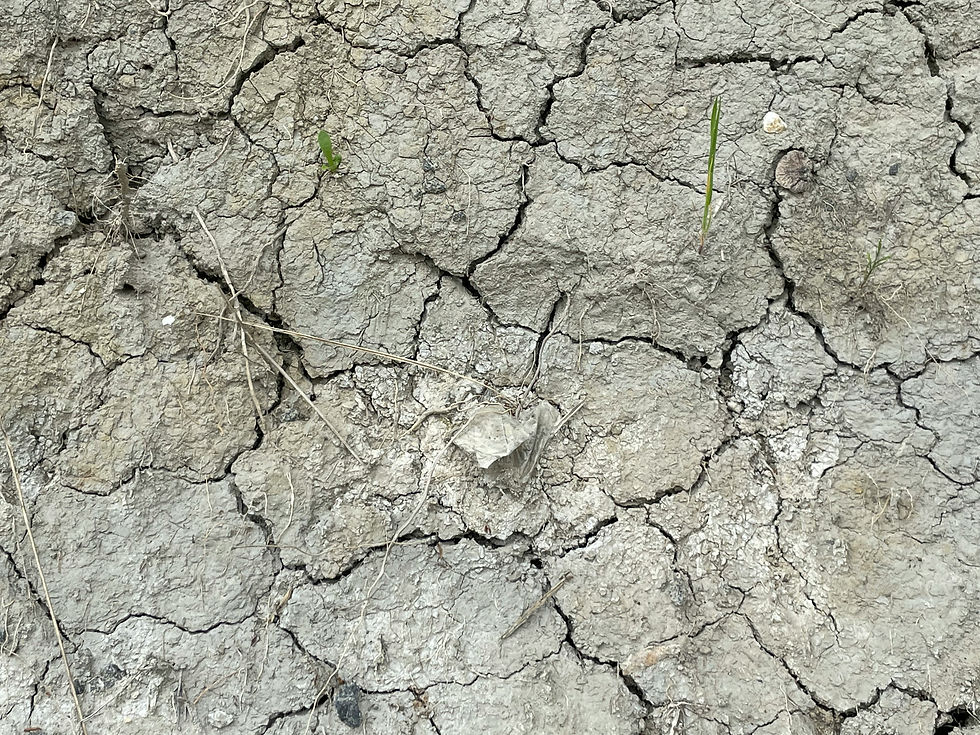
Salinity usually starts in the low spots. Rain and snowmelt soak into higher ground, pick up dissolved salts as they move through the soil, and carry those salts downslope into low-lying areas. When the water sits and evaporates, the salts get left behind. It's a natural process — but continuous annual cropping makes it worse, because annual crops don't pull as much water from the soil as native prairie vegetation did.
When you take water-hungry crops out of the equation, more water reaches the water table — and that raises the water table in low spots, which pushes salts closer to the surface. [3]
Once salinity takes hold, it tends to snowball. Salt-tolerant weeds like foxtail barley and kochia move in, crowd out your crop, and leave the ground bare. Bare ground evaporates more water, which concentrates more salt. The patch gets worse and spreads.
AAFC estimates that roughly 30 per cent of prairie agricultural land is either already saline or at risk of becoming saline. [4]
How does alfalfa help manage and prevent soil salinity?

Alfalfa works on salinity in a pretty straightforward way: its roots go deep — much deeper than any annual crop — and pull large amounts of water up from the subsoil. That lowers the water table in the higher ground that feeds water to your low spots. Less water moving downslope means fewer salts being deposited in those discharge areas.

University of Saskatchewan (USask) forage breeder Dr. Bill Biligetu put it directly: "Alfalfa is useful because it can lower the groundwater table, preventing further salinization." [5]
Alfalfa roots typically go 2 to 3 metres deep under Saskatchewan growing conditions, and deeper in well-drained soils. Annual crops don't come close to that. [6]
Manitoba Agriculture's salinity management guide recommends planting alfalfa or other deep-rooted forages in a 20 to 60 metre band on the higher ground that drains toward your saline areas. That upslope planting intercepts water before it ever reaches the problem zone. [7]
There's a secondary benefit too: alfalfa breaks up the soil and improves drainage. When rain does fall, water moves down through the soil profile instead of sitting on the surface and evaporating — which is exactly what concentrates salts in the first place.
Worth being clear about: forages manage saline acres, they don't fix them. Dr. Biligetu: "It's pretty hard to really reduce it. Plants can take up some salt and surface conditions may shift, but not enough to turn saline land back into non-saline cropland." [5] The goal is productive, stable management — not a permanent cure.
When is the right time to establish forages for salinity management?
Timing is everything — and most producers wait too long.
Adrienne Ivey saw this play out on her own land. During the wet years around a decade ago, the low spots on annually cropped fields turned saline as the land dried out and salts came back to the surface. The fields that already had alfalfa on them barely showed the problem:
"The difference in the land between annual cropping and land that had alfalfa was night and day difference." — Adrienne Ivey, mixed farmer, Ituna, SK — SaskSoil Webinar
Saskatchewan's provincial soil survey is direct on this point: saline soils should be seeded to long-term forage as soon as possible. Waiting lets the problem get ahead of you. [3]
USask research confirms what producers already know from experience: once foxtail barley and kochia get established in a saline patch, forages have a very hard time competing against them during seedling establishment. The window for easy action closes fast. [5]


The practical takeaway: keep an eye on your low spots every year. Look for thin crop stands, yellowing patches, ground that stays wet longer than the rest of the field, or any foxtail barley showing up. Don't wait until you've got a white salt crust — by then the weed pressure will make establishment a real fight.
What forage species work best on saline soils in Saskatchewan?
Which species to seed depends on how bad the salinity is and what you need the forage to do (feed, weed control, or both). Standard alfalfa is your best starting point — it’s the most salt-tolerant legume we grow on the prairies and the only species that actively lowers the water table.
However, when it comes to seeding saline areas, a blend almost always outperforms a single variety. Saline patches are rarely uniform — EC levels can shift significantly within a few metres, and what establishes well in a moderately saline low spot may struggle where salinity is more severe. A blend hedges against that variability. USask research from the Biligetu lab tested this directly on moderately saline sites near Clavet and Redvers, SK, and found that mixes of a salt-tolerant alfalfa with slender wheatgrass, creeping meadow foxtail, or smooth bromegrass all established well — with the alfalfa contributing water table management and the grasses providing weed competition against foxtail barley and kochia. No single species did both jobs as well as the mix did together. [5][8]
When you're talking to your seed rep, ask specifically for a saline mix or salt-tolerant forage blend suited to your soil zone — most major forage seed companies carry one. Look for a blend that includes a salt-tolerant alfalfa variety as the legume anchor and at least one competitive grass species (slender wheatgrass and creeping meadow foxtail are both well-documented performers on prairie saline ground). Avoid blends that are grass-only if your site is only moderately saline — you'll lose the water table benefit that alfalfa provides. Seed heavier than the bag recommends; establishment on saline ground is less predictable, and a denser initial stand gives you more to work with if germination is patchy. [5]
Note: Commercially available saline forage blends vary by region and year. The NAFA Variety Ratings database (alfalfa.org) is updated annually and includes salinity tolerance ratings for submitted varieties — a useful cross-check before you buy.
One practical note from Dr. Biligetu: seed heavier than you normally would on saline ground. Results are less predictable on marginal soil, so a denser stand gives you more of a buffer if establishment is patchy. [5]
For mixed farms with cattle: a barley companion crop — cut for whole-plant silage or greenfeed, not grain — can give you some feed value in the first year while the perennial stand gets going. The USask trial found barley grew at the Clavet and Redvers saline sites, but grain fill was poor. Use it for forage, not for the bin. [8]
Access the full report Using perennial forage mixtures to reclaim saline land: Establishment success, forage yield, and environmental benefits.
What do EC readings actually mean for your soil?
EC is the number your soil test lab gives you for salinity. Here's what those numbers mean in practical terms for Saskatchewan producers, and what to do at each level.
Salinity level | EC (dS/m) | What you might see in the field | How crops handle it | What to doSalinity level |
Slight | 1–4 | Thin stands in the low spots; no visible salt crust yet | Most crops still viable; peas and lentils start struggling first | Keep an eye on it; try alfalfa on the higher ground feeding into the low spots; rotate in salt-tolerant varieties |
Moderate | 4–8 | Uneven stands; possible white-grey crust on dry soil; foxtail barley starting to show up | Wheat and canola take a yield hit; barley and oats hold up best | Seed to long-term forage now — standard alfalfa on higher ground; salt-tolerant wheatgrass or grass mixes in the saline low spots |
Severe | >8 | White crust most of the time; foxtail barley and kochia dominant; crop fails in patches | Annual cropping isn't viable in these spots | Tall wheatgrass or high-salt grass mixes in the worst areas; alfalfa on the perimeter and upslope ground to slow further spread |
Table 2. What EC levels mean for Saskatchewan prairie soils, based on Manitoba Agriculture [9] and AAFC Swift Current research [4].
The Government of Saskatchewan's land capability system rates severely saline soils as Class 5N — not suitable for annual crops and best managed as permanent forage. Even Class 4N (moderately saline) carries very severe limitations for common field crops. [10]
Learn how to choose the right soil test with Wheat School by RealAgriculture and check out Canadian Organic Grower's report on Interpreting a Soil Test for help understanding your results.
Does adding cattle help with salinity management?
Cattle don't fix salinity directly — that's the forages' job. But on a mixed operation, having cattle graze the forage land speeds up the broader soil health improvements that make saline areas more stable over time.
On Adrienne's farm, the fields that came back the best from salinity problems were the ones with the longest history of forages and cattle together, not forages alone. The manure, the litter from leftover feed, and the physical impact of hooves on the ground all add organic matter and improve how the soil handles water.
Manitoba Agriculture includes manure and crop residues as one of the few inputs that actually helps saline soils — alongside forage establishment. [9]

Better organic matter means better drainage and less ponding. Less ponding means less evaporation from the surface. Less evaporation means fewer salts concentrating at the top. It's not a dramatic fix, but over a full rotation it adds up.
How do you catch soil salinity early and get ahead of it?
The earlier you catch it, the easier it is to deal with. Here's what to look for and what to do, drawing on recommendations from the Government of Saskatchewan, Manitoba Agriculture, and Soils of Saskatchewan.
Scout your low spots every year. You're looking for crop stands that are thinner than the rest of the field, patches that yellow early in a dry stretch, ground that stays wet longer after rain, or a grey-white colour on the soil surface when things dry out. These show up before the salt crust does.
Watch for foxtail barley and kochia. Both weeds love salty ground and move in early. USask researchers say their presence — even just a few plants — is a reliable sign that salinity is developing. If you're seeing them pop up in low spots, it's time to act. [5]
Soil test any suspect areas. An EC reading tells you how bad it is and which forages will work. Sample the problem area and a nearby non-affected area, both to 60 cm (2 feet) deep, so you can compare. Don't rely on a composite field sample — those average out the salinity and can hide a developing hot spot. [9]
Check SKSIS (Saskatchewan Soil Information System). The province's soil mapping tool shows historical salinity ratings and land capability classifications for your land. It's a good first check before you see field symptoms — or when you're looking at buying or renting new acres.
Figure out where your higher ground drains to. Those upslope areas are where you can do the most good — alfalfa planted there pulls water from the soil before it ever reaches the saline low spot. A 20 to 60 metre band of alfalfa on that higher ground can make a real difference. Topo maps, satellite imagery, or a walk around the field after a rain event are all ways to see where the water flows. [7]
Seed forages on the high ground first, before you tackle the low spot itself. Getting that water interception going upslope is more effective long-term than only treating the visible saline area.
Common mistakes producers make with saline soils
Waiting until it's bad. Once foxtail barley takes over, even salt-tolerant forages struggle to get established. USask research confirms that seeding perennial cover before weed pressure takes hold is what works — not after. [5]
Seeding regular alfalfa into the worst spots. Standard alfalfa handles moderate salinity, but in a severely saline discharge zone it will likely fail. Save the standard alfalfa for the higher ground and use a salt-tolerant wheatgrass or grass mix in the saltiest areas. New high-salt-tolerance varieties are in the pipeline from USask and AAFC Swift Current — check with your seed rep for what’s currently available.
Only treating what you can see. If you seed the saline patch but ignore the higher ground that's draining water into it, you've slowed the problem but not stopped it. The upslope management is the most important piece. [7]
Expecting a short forage rotation to hold the improvement. Going back to annual cropping after 2 to 3 years in forages brings the water table back up and the problem back with it. Many producers treat known saline areas as long-term or permanent forage ground. If you do want to rotate back, track your EC numbers annually first so you know what you're working with.
Thinking forages will eliminate salinity. They won't — USask is clear on that. What forages do is make saline acres more productive and stop them from getting worse. Set that expectation before you seed.
What two decades of mixed farming looks like on variable ground
Adrienne Ivey's land near Ituna is the kind that tests a rotation: rolling terrain, wetlands throughout, and soil that changes dramatically from hilltop to low spot within the same quarter. Salinity management isn't a one-time fix on land like that — it's built into how the whole farm runs.
One thing she flagged that doesn't come up in research papers: land coming out of a long forage stand tends to be drier in the spring than annually cropped ground. Alfalfa pulls so much water from deep in the soil that the profile is genuinely drier when you're ready to break it out of forages. In a wet spring — and the Prairies have had a few — that's a real advantage. You can get in and seed sooner than your neighbours.

Frequently asked questions
Can I still grow annual crops on saline soil?
Yes, on slightly saline ground — but your options narrow as EC climbs. Barley and oats are the toughest cereals for salty conditions. Pulses like field peas and lentils are the most sensitive and start taking a hit at EC levels as low as 1.5 dS/m. Canola is roughly as tolerant as barley once it's up and growing, but because it seeds shallower, it's more exposed to salt fluctuations at the surface during germination. None of these crops fix the problem — they just tolerate it to varying degrees. Only perennial forages actually work on the water table. [4]
How long before alfalfa makes a difference to salinity?
The water table starts coming down in the first growing season — alfalfa is pulling water from day one. But measurable improvement in your EC readings usually takes 3 to 5 years of continuous forage cover. Don't expect a soil test after one season to show dramatic change. Take a baseline reading when you seed, then sample the same spots every year. You'll see a trend develop.
If I take forages off, will the salinity stay improved?
Not reliably. Going back to annual cropping puts you back to the same water-use pattern that let salinity develop in the first place. Saskatchewan's provincial soil survey recommends long-term or permanent forage for known saline areas — not a short rotation. If you want to bring saline acres back into grain production, track your EC over several years first and go in with realistic expectations. [3]
What is foxtail barley and why should I care about it?
Foxtail barley (Hordeum jubatum) is a native prairie grass that thrives in salty soil. It's one of the first weeds to colonize a developing saline patch, and both Manitoba Agriculture and USask researchers recognize it as an early warning sign for salinity. If you're seeing foxtail barley creeping into your low spots, salinity is already developing. More importantly: once foxtail barley is thick in a spot, it's aggressive enough to crowd out forage seedlings — which means your window for easy establishment is closing. [5,9]
I'm a grain farmer with no cattle. Does this still apply to me?
Yes. Dr. Biligetu from USask is straightforward on this: even if you have no use for forage, seeding salt-tolerant perennial cover on your saline patches beats leaving them in annual crops that fail or produce junk stands. Perennial cover keeps the weeds down, improves soil biology, and — if you go with a pollinator mix — can even help your canola yields in adjacent fields. It's less about generating forage revenue and more about stopping those patches from getting bigger and more expensive to deal with. [8]
You can still plant forages without owning livestock. Our webinar with RealAgriculture’s Lyndsey Smith covers how to reap the benefits of grazing forages with a little help from your neighbours. Find it on our YouTube channel.
About This Resource
This article is drawn from a SaskSoil webinar featuring Adrienne Ivey, a mixed farmer from Ituna, SK, who farms 5,000 acres of grain and runs a 500-head commercial cattle herd with her husband, Erin. Adrienne has been managing rolling, wetland-heavy land in east-central Saskatchewan for more than two decades — long enough to see how salinity behaves through both the wet years and the dry ones.
Watch the full webinar on YouTube: Rebuilding Soil with Forages and Cattle
Sources and further reading
Primary sources cited in this article:
[1] Adrienne Ivey. SaskSoil Webinar: Rebuilding Soil with Forages and Cattle. June 2, 2026. https://youtu.be/bUQ9_-62s-M?si=pcTVgLC8jgvfnckm
[2] Iwaasa, A. Agriculture and Agri-Food Canada, Swift Current Research and Development Centre. Cited in: Canadian Cattlemen. "Managing Soil Salinity for the Long Haul." April 2025. https://www.canadiancattlemen.ca/features/managing-soil-salinity-for-the-long-haul-2/
[3] Soils of Saskatchewan — Salinity Class. University of Saskatchewan / Provincial Soil Survey. https://soilsofsask.ca/soil-survey-soil-characteristics/salinity-class.php
[4] Top Crop Manager / AAFC. "Salinity Solutions." Agriculture and Agri-Food Canada Salinity Tolerance Testing Facility, Swift Current, SK. https://www.topcropmanager.com/salinity-solutions-15902/
[5] Biligetu, B. and Waldner, A. University of Saskatchewan, College of Agriculture and Bioresources. "USask Researchers Aim to Reclaim Saline Soils." January 2023. https://agbio.usask.ca/news/2023/01/usask-researchers-aim-to-reclaim-saline-soils.php
[6] Tandfonline, 2025. "The Role of Alfalfa (Medicago sativa L.) in Soil Health." https://www.tandfonline.com/doi/pdf/10.1080/03650340.2025.2610090
[7] Province of Manitoba Agriculture. "Forages for Improving Saline Soils." https://www.gov.mb.ca/agriculture/crops/crop-management/forages/forages-for-improving-saline-soils.html
[8] Waldner, A. et al. "Using Perennial Forage Mixtures to Reclaim Saline Land: Establishment Success, Forage Yield, and Environmental Benefits." Field Crops Research, March 2026. University of Saskatchewan / Western Applied Research Corporation / South East Research Farm. https://www.sciencedirect.com/science/article/pii/S0378429026001267 or https://harvest.usask.ca/server/api/core/bitstreams/3c19ae6c-9fc7-41e5-959f-56ac253c9de8/content
[9] Province of Manitoba Agriculture. "Soil Salinity" in Soil Management Guide. https://www.gov.mb.ca/agriculture/environment/soil-management/soil-management-guide/soil-salinity.html
[10] Soils of Saskatchewan — Agricultural Capability. https://soilsofsask.ca/soil-survey-soil-characteristics/agricultural-capability.php
Additional recommended reading:
Government of Saskatchewan. "Agricultural Soils of Saskatchewan." https://www.saskatchewan.ca/business/agriculture-natural-resources-and-industry/agribusiness-farmers-and-ranchers/sask-ag-now/improving-business/agricultural-soils-of-saskatchewan
Government of Saskatchewan. "Soil Improvements with Legumes." https://www.saskatchewan.ca/business/agriculture-natural-resources-and-industry/agribusiness-farmers-and-ranchers/crops-and-irrigation/soils-fertility-and-nutrients/soil-improvements-with-legumes
SaskToday. "Kochia's Rise Reveals Deeper Soil Troubles on Prairie Farms." October 2025. https://www.sasktoday.ca/southeast/carlyle-observer/kochias-rise-reveals-deeper-soil-troubles-on-prairie-farms-11336030


Comments